
Your cart is empty.
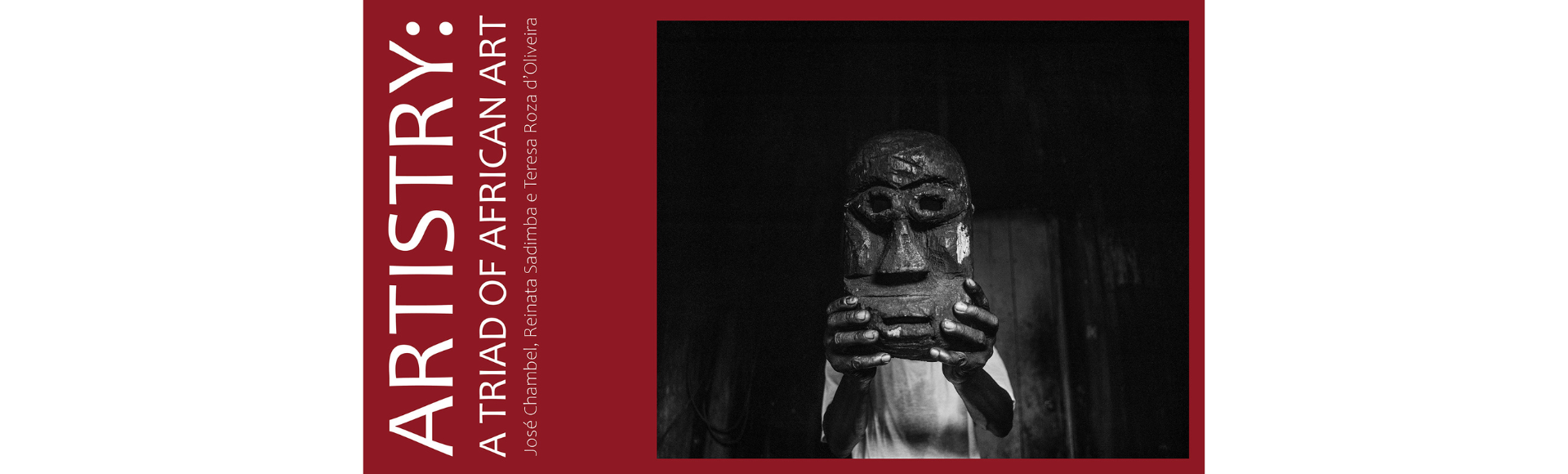
Perve Galeria is honoured to present the exhibition "Artistry: a Triad of African Art", which establishes a dialogue between the artworks of José Chambel (1969, São Tomé and Príncipe), Teresa Roza d'Oliveira (1945-2019, Mozambique) and Reinata Sadimba (b. 1945, Mozambique). Opened on May 26th, in the context of Lisbon's Art Week, the show extends the relations established at the prestigious contemporary art fair ARCO Lisboa, where Perve Galeria participated in the Africa in Focus section, at the invitation of its curator, Paula Nascimento. On July 29th, as part of the exhibition's finissage, there will be a guided tour by the curator, Carlos Cabral Nunes, at 3pm.
Image gallery of the artworks on display: link
Perve Galeria
Artistry: a triad of African art
José Chambel, Reinata Sadimba, Teresa Roza d’Oliveira
May 26 - July 29
Tue - Sat: 2pm - 8pm
Presenting a wide range of artworks, most of them shown to the public for the first time, the exhibition Artistry: a Triad of African Art, at Perve Galeria until July 29th, explores the different artistic expressions and languages from the African continent, putting into dialogue the ceramics of Reinata Sadimba (1945, Mozambique), the painting of Teresa Roza d'Oliveira (1945-2019, Mozambique) and the photography of José Chambel (1969, São Tomé and Príncipe).
Owner of an extremely eloquent work that, even linked to Africa, is capable of internationalising and communicating with any geography or language, Reinata Sadimba, a self-taught and illiterate artist from the Makonde ancestral community, was born in 1945 in the small village of Nemo, on the Mueda plateau, Cabo Delgado province. From an early age, she took an active role in the defence of her people, participating in the liberation movement of her country, in the face of the Portuguese dictatorial and colonial regime. After the independence of Mozambique in 1975, having lost six of her seven children, Reinata dedicated herself to figurative terracotta sculpture, emancipating herself both from her husband, a daring move in the 1970s, and from her ethnic group, which forbade women to develop figurative sculptural artwork, allowing them only to make utilitarian ceramic objects. By exhibiting a group of artworks representative of her prolific career, this exhibition allows us to access the artist's inexhaustible creativity and the fantastic and surreal character of her anthropomorphic terracotta figures. Sculptures that physically and symbolically connect us to the earth, alluding to the purifying power of an artistic process anchored in popular and ancestral wisdom.
Unveiling an intimate sense of freedom, set against patriarchal and heteronormative constraints, Teresa Roza d'Oliveira's pictorial world is inhabited by strange characters and anthropomorphic animals. A Portuguese-descendant artist, an important activist for the independence of Mozambique and the end of the Portuguese dictatorship, she was part of a generation of Mozambican artists that included Alberto Chissano, Malangatana Ngwenya or Ernesto Shikhani. Despite the importance of her work, she ended up being the object of historical erasure, mainly because she divorced her husband and father of her two children in the late 1970s to live a homosexual relationship, which she would later turn into marriage. In the African context, homosexuality, and female homosexuality in particular, is far from being a peaceful subject, and women are still ostracised for coming out. Doing so, as an artist, at the time Teresa did, demonstrates her unrivalled strength, also expressed in her artworks, which hold an expression that fights to affirm a truly free identity. In 2022, her artistic estate was integrated into Perve Galeria's collection, which, with Freedom's House - Mário Cesariny, held its first anthological exhibition between March and May 2023, entitled Hands of Sculpture & a visionary on the island (of Mozambique), which put her work in dialogue with that of Reinata Sadimba.
Through a socially and politically problematising lens, José Chambel's photographic language is of a documentary nature, imbued with artistic expression. In his practice, the author is concerned with the preservation of the tangible and intangible cultural heritage of São Tomé and Príncipe, Portugal and Cape Verde, and, despite being deeply rooted in his heritage, he belongs to a generation of artists committed to encouraging the act of rethinking the image of Africa. Presenting a set of photographs from the most significant series of his career, such as Capital (2000), Di Ké Mu (2016) or Danço Congo (2016-2018), the exhibition marks the 25th anniversary of the realisation of Págá Dêvê (1997) and Tchilóli (1997), in which Chambel documented one of the most important forms of santomean dramatic expression. Hybrid, subversive and anachronistic in character, it stages the Tragedy of Emperor Charlemagne and the Marquis of Mantua, a text that arrived in São Tomé in the 16th century, when the island was a slave depot. As a whole, these photographs subvert the concept of pure identity, demonstrating how cultural identity is established in the encounter of difference and the transformations it triggers.
It is precisely from these plural and prolific encounters that this exhibition is established, allowing access to the multiple and varied ways in which the triad of African artists look at and interpret the world from a particular individual position and identity.